
A little more than 24 hours ago, I decided to give Tumblr a try. As I started using it, I found myself thinking about Tumblr Engagement vs Social Media on other platforms. In fact, Tumblr Engagement vs Social Media is a topic many people overlook, but it’s worth exploring. I know… it’s been around since what feels like the beginning of time. How am I just now experiencing it? I hear you.
Technically, I did briefly try it years and years ago. However, back then, I wanted to be where the “cool kids” were—on X (formerly Twitter), Facebook, or Instagram. That’s where all the action seemed to be. If I told my friends I was on Tumblr, they would all just ask, “Where!?”
Recently, something changed. Since starting my company, I’ve been on all those major platforms for months, and do you know what my engagement has been? Almost zero. Months of screaming into the void was exhausting.
This is not a popularity contest. My goal has never been about how many followers I can get to look cool; it’s about field research. You can’t be a field researcher and collect information through polls, likes, comments, or reposts if not a single person is actually doing any of those things.
That’s like holding a public speaking event in your own house and talking to the wall. You might have awesome things to say, and you might even be an expert on your topic, but if nobody is around to hear you or engage in real-time conversation, the entire thing becomes pointless.
The 24-Hour Experiment: Tumblr Engagement vs. Social Media
24 hours ago, I decided to make a change. If I can’t reach in the top guys, why not make some noise in the smaller communities? So, I took the plunge and I tried a few but none of them stuck. And then it was Tumblr’s turn and do you know what I found in 24 hours?
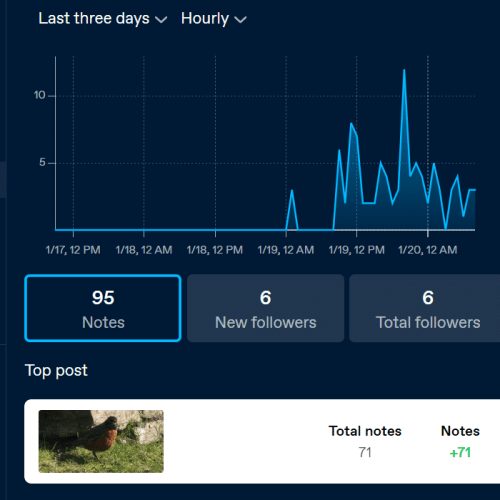
In 24 hours I’ve gotten hundreds of engagement. This experiment really made me question Tumblr Engagement vs Social Media, especially with how dramatically different the results were. this includes likes, follows, reblogs, replies, and voting in polls! Tumblr does not count the poll votes which is why the number is less than a few hundred in the image. But trust me, those are just as important!
It’s easy to get caught in the trap of thinking “Maybe, I’m just not good enough. Maybe people don’t care what I have to say. Maybe I’m just not good at what I do” and people on most of those platforms will scream “NO! YOU’RE NOT GOOD! YOU SUCK!” Tumblr Engagement vs Social Media can truly affect how people feel about their content’s value.
As a field researcher, I’ve realized something deeper: when people actually see what I’m about and hear what I have to say… they listen. They believe. That’s because I’m not trying to be an “expert” in anything; I never claimed to be.
My entire website was built around the concept of me learning in real-time along with you. This is exactly what independent field research is. I’m currently taking online courses for animal and wildlife education to back up my work. Consequently, Tumblr Engagement vs Social Media plays a big role in shaping my approach as a researcher.
Digital Ethology: Using the Scientific Method on Tumblr
I would even call myself a citizen ethologist. Observe. Report. Then, I come back home and research facts to better understand the animals I saw. I don’t claim to know everything about wildlife.
I look up all my answers, and that’s what a good citizen ethologist does. They don’t make things up or claim to have all the answers. They observe wildlife in their natural environment and say, “This groundhog stared at me for a few minutes. He popped out of his hole, but he isn’t running in fear.” Then, they go home and do more research online to find out what that behavior actually means.
Withing hours, thanks to Tumblr, I can have results almost instantly and now just wait for months like on other platforms for even one person to vote on a poll or for a single like.
Funny tidbit: When I was new on Tumblr, I said something like, ‘I can’t wait to collect all your data!’—which is NOT something you want to say! Especially as a company. Of course, what I meant was gathering the anonymized results from polls for my research. On this website, I use standard tools like Stripe to keep things running, but on Tumblr, I’m just a silent observer watching the ‘natural habitat’ of the reblog.
Conclusion: The Data Doesn’t Lie—Tumblr Wins
Does Tumblr have its faults? Sure. There is no perfect platform. On a website where I try to be as wholesome and educational as possible, I could certainly do without the mature adult content over there. Not to mention the bots—though every platform has bots.
It sucks more on Tumblr because when you have genuinely good content and your hashtags get drowned out by bots using those same tags, it is incredibly frustrating.
However, it is the best platform for getting real-time results. Not to mention, my posts actually have staying power. We are going into the second day, and my posts are still getting likes as I write this.
For the most part, it’s easy to tell which likes are from real people and which are from bots. I am also getting actual interactions with people. Could they still be AI? That’s a conversation for a different day.
Hopefully, this blog will teach people that, sometimes, the problem on social media isn’t your content; it’s just that you’re fighting the algorithm.
Unless you’re willing to pay to boost all your posts or run ads, you are most likely going to see little to no interaction—even if you’ve been on the platform for years.
Actually, I tried boosting one of my posts on Tumblr. Do you want to know the honest results? It did decently. It had the most votes I’ve ever seen for a poll, but in terms of likes and reblogs, it didn’t do that well. In fact, one of my regular, non-boosted posts did infinitely better for likes, reblogs, and comments. Do with that information what you will.
Field Research Disclaimer: This content is for entertainment and conceptual purposes only. I am not a medical, legal, or financial professional. Please do not attempt these challenges or observations in any setting—private or public. Ensure your own and others’ safety. Consult a professional as well. All findings are independent observations of the Comfy Chaos Collective.
Leave a Reply